What UEF tells you
UEF stands for uniform energy factor, a federal rating of how much of the energy a heater uses ends up as hot water. A higher number means less waste, and the label lets you compare one model against another.
Condensing tankless models capture extra heat from exhaust and reach the highest ratings. Intermountain Gas Company's residential tankless rebate, for example, sets a 0.91 UEF minimum, which shows the bar for the most efficient gas units.
Where tankless saves and where it does not
| Factor | Effect |
|---|---|
| No standby loss | A tank keeps water hot all day, while tankless heats on demand |
| Condensing design | Captures exhaust heat for higher UEF |
| Household use | Low hot water use saves less than heavy use |
| Cold incoming water | Reduces flow at a given set temperature |
| Hard water scale | Cuts efficiency until the unit is flushed |
| Fuel type | Gas and electric costs differ by rate |
Want your numbers worked out?
Call and a plumber will ask about your household and compare tankless against a new tank, with a clear price.
Cold winters change the math
NOAA normals for the nearby Nampa station show a January average low near 23 degrees F and about 132 days a year at or below freezing. Water entering the house in winter is colder, so a tankless heater has to add more heat to reach the same temperature, and its maximum flow drops.
In practice a unit sized for summer may struggle with two showers in January. Ask the plumber to size the unit for winter water, not the spring average, and consider a larger model if your household is busy in the morning.
Rebates, scale and Caldwell homes
Rebates for efficient gas heaters come from gas utilities rather than the city. Intermountain Gas Company's tankless rebate requires a minimum 0.91 UEF and an application within 90 days of installation. Ask your own gas provider whether a program applies to you, because we do not name a provider for Caldwell addresses.
About 56 percent of Caldwell's homes were built in 2000 or later, according to Census Bureau estimates, and many have gas lines sized for a tank. Upsizing the line is often the largest extra cost of switching to tankless.
Source: Intermountain Gas Company rebate page, U.S. Census Bureau ACS 2020 to 2024 and NOAA 1991 to 2020 normals
Upkeep protects the efficiency
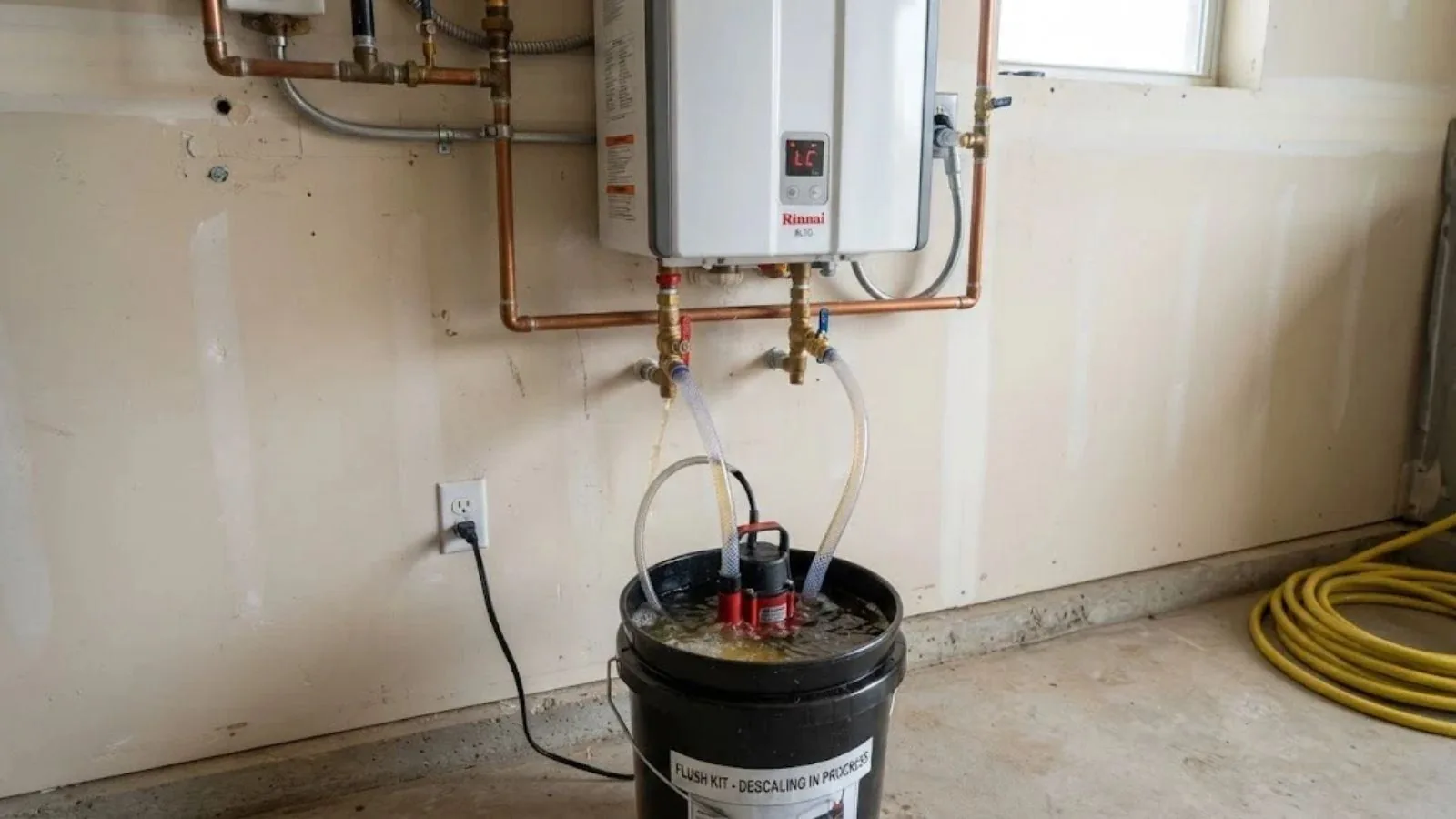
Scale on the heat exchanger acts like insulation, so efficiency slips as it builds. Yearly flushing through isolation valves removes it, and in hard water a softener or a descaling filter may be worth it.
Caldwell's city reports do not always list hardness, so test your tap or ask the water department at 208-455-3070. If your water is hard, see water softener installation for how a unit fits in.
Small habits that cut hot water use
The cheapest efficiency gain is using less hot water. A low flow showerhead, a lower setpoint of around 120 degrees F and shorter showers all reduce the load on any heater.
Insulating the first few feet of hot water pipe and fixing dripping faucets also help. A hot water leak wastes both the water and the energy used to heat it, and fixing it is a quick win.
Reading the manufacturer's numbers
Manufacturers publish maximum flow rates at a given temperature rise. Read those tables against your winter incoming water temperature, not the number in the brochure headline.
Ask the installer to show the flow at your expected rise, and ask what happens when two fixtures run at once. A model that falls short in January may be fine in July, and you live in both seasons.
Tankless compared with a heat pump
Heat pump water heaters are electric tanks that move heat from the air, and they can use far less electricity than a standard electric tank. They cool the room they sit in and need open space, which suits a garage but may not suit a closet.
A gas tankless unit makes sense when gas is already available and the household wants endless hot water. A heat pump makes sense when the house is all electric and the unit has room. The best option is the one that matches your fuel and your space, as covered on the water heater installation page.
Questions Caldwell homeowners ask
It depends on usage and fuel cost. Households that use little hot water save less, and busy households save more. A plumber can estimate based on your use.
Yes. Colder incoming water means the unit has to add more heat, so maximum flow drops. Caldwell winters average about 132 days a year at or below freezing, so size for winter.
Higher is better. Condensing gas units reach the top of the range, and Intermountain Gas Company's rebate sets a 0.91 minimum.
Yes. Flush the heat exchanger about once a year, more often in hard water.
Not unless it has a backup. The fan and controls need electricity even on a gas unit.
Yes. See the page for Middleton and the service areas.